Well, sorry I wasn’t here last week. The weather has been awful and it has gotten me down bigtime. Mostly, we had those storms, and I was absolutely amped to plant out my summer-loving plants over Labour weekend. Then the weather was so terrible on Labour weekend, I ended up planting out a few things simply because I wanted to feel good! And of course we had more storms immediately afterward. This week it took me till Wednesday to feel better. I have been visibly angry and raging about it, which is quite a silly thing for most of you, but for me, I don’t know. It broke me. At work at the moment it is considered normal to go from a hot tshirt day to being hailed on within the space of a few minutes. I am finding it difficult to overcome the frustration!
But then we had THREE nice days in a row! So I am back, perky and positive. For now.
I also have about a thousand things to share so let’s hop to it.
Trimming hedges
We are still only really trimming (ie, using shears and a hedgetrimmer) on hedges when-
They are natives, like corokia or coprosma, or they are tree hedges that are only loosely trimmed;
If they are hebes we are trimming them very delicately (ie not too far)
We really have to, they are too out of shape;
When we have a fully dry day prior and no hint of rain (to reduce the chance of fungal infection).
I know this seems overkill, but the wind has been blasting us here in Wellington, and there is a lot of dead on some hedges (and some plants generally). The cold damages new shoots whether there is wind or not, and if you trim a delicate hedge then any weather damage is exacerbated.
“But I see people on Instagram with perfect, square hedges!,” you say. Yes, if you regularly (like 2-4 weekly year round) trim your hedges, then you can trim them sooner in Spring (because you are trimming them aggressively year round). If you want to spend hours every fortnight trimming your hedges then you do you. Just keep it up and consistent.
We do have properties with perfect, square hedges. They pay us to do this and we love them for that. At the end of the day it’s a bit like a manicured lawn, if you are willing to put in the time and money then everything is possible!
For the rest of us, people who do not have limitless pockets or limitless gardening time, trimming a few times a year is ideal! I think we do most hedges 6-7 times a year. Buxus only 3-4 times.
If you have buxus and want to trim it into shape, and just can’t wait, here is an example of one I carefully trimmed today-
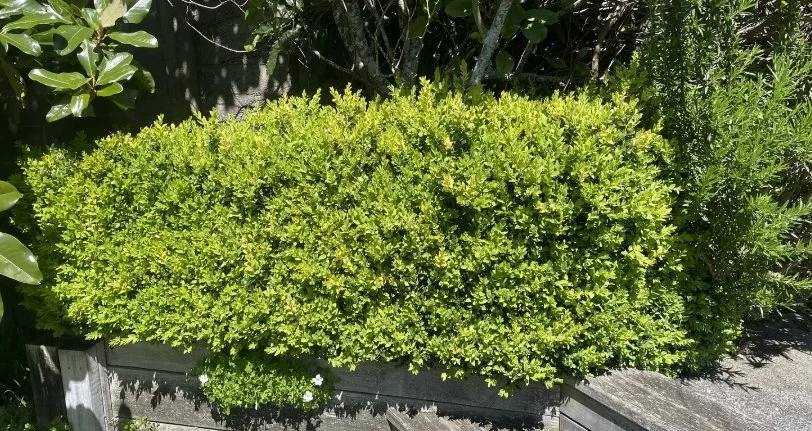
No, this photo is not on a funny angle. The hedge is! It is way too tall on the right hand side.
So I want to take it down, I don’t want to cut into last year’s wood though- that means I am taking the shaggy light green stuff off but not the darker green, and then leaving it till December-
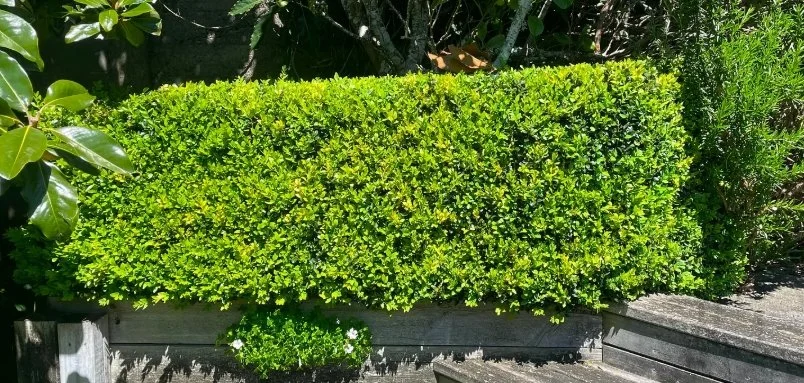
You can see that I haven’t taken it right down flat, because it would cut too hard into the hedge. if I cut too hard into it right now the growth will be massively stunted this growing season, so for now it is tighter and shaggy, in December it will get a proper trim to make it fully square.
What *is* really important to do right now. Right this second, please
Identify where plants are touching/lying on/too close to your hedge and cutting them back so they are not physically touching the hedge. Like this-
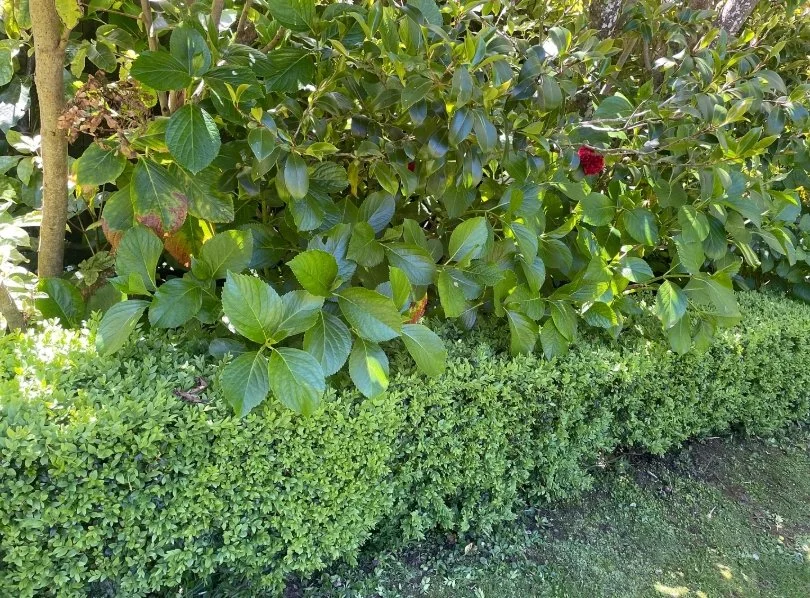
See how these hydrangea leaves are sitting on top of this hedge? They are inviting fungal issues and restricting the light to the top of the hedge, so the top of the hedge will die back. I did what is effectively a crown lift- removing the lower shoots-
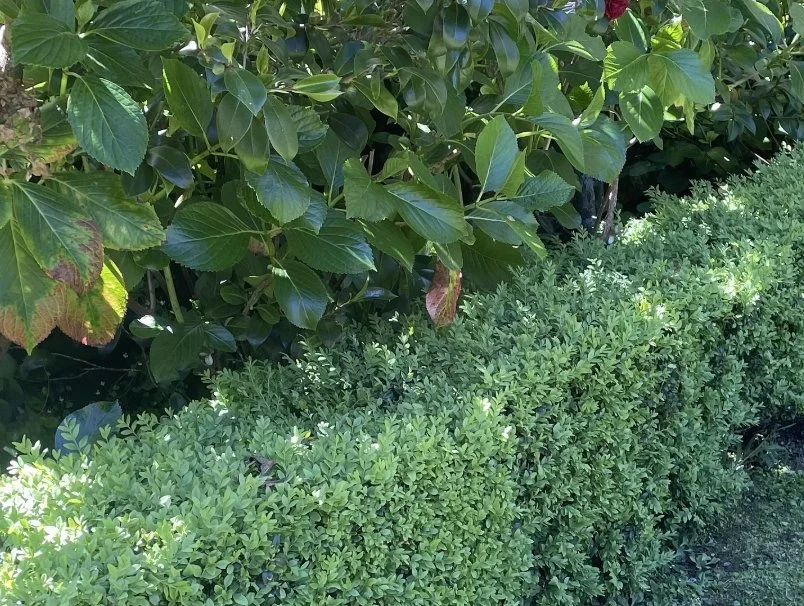
Perfect! Remember that if your plants are pushing up against each other they are probably competing for light, and might get/stay too damp. This is good in places like the seaside, where any shade and moisture are good for a plant, but not good in most gardens, unless you are deliberately trying to get the area a bit darker and damp-er- like where you have ferns.
The other thing I have to say about hedges is that you will hate your life unless you make sure your tools are sharp. A hedgetrimmer is ALWAYS worth the investment. Sharp hedgetrimmer, loppers if you are taming an overgrown larger hedge, sharp shears for corners and awkward bits. Sharp, sharp, sharp. Sharpen annually at the very least!
Some cute lawn pics
We are often asked about lawn replacement and today I happened to be on lawn duty, so I got some photos for you of regular lawns which are being helped along a bit.
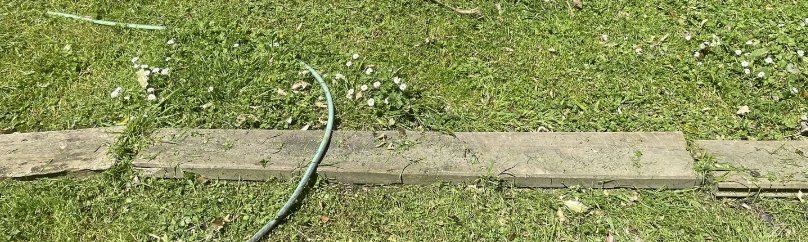
Client wants more daisy less grass -we literally just don’t mow the daisy patches so they self seed everywhere.
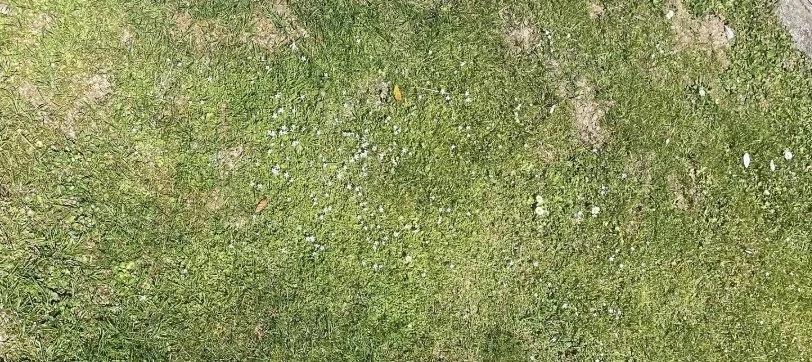
This lawn is full of Lobelia ‘blue stars.’ You can see that it doesn’t tolerate grass well anyway- see the bare spots- and that the lobelia is forming a light green mat. There is still grass in there. we just plant a couple of pots of lobelia when the client feels like splurging. You can get Lobelia for lawns from Dave at No Mow. Link
Please see here that we are not making any particular effort. We are not actually removing the grass (a long, drawn out process). We are just planting other stuff within the lawn and enjoying the variations.
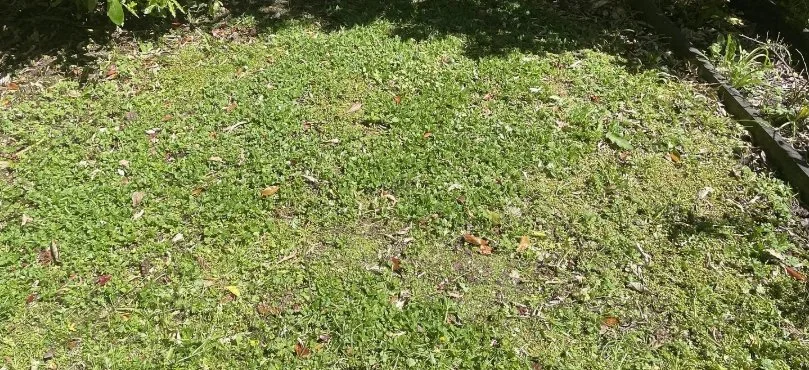
This just looks like a somewhat crappy lawn from afar but it is mostly Self Heal (Prunella Vulgaris), and this part of the lawn doesn’t get any sun from May to September. The grass struggles hard, but the Self Heal loves it, keeps it green and has some cute flowers in Summer.
Where do you get Self Heal? I honestly just weed it out of one person’s garden and put it in another. So I am not helpful! I haven’t seen it in shops. Once it is in your lawn, if you leave it to self seed, you will get it everywhere. I just love it.
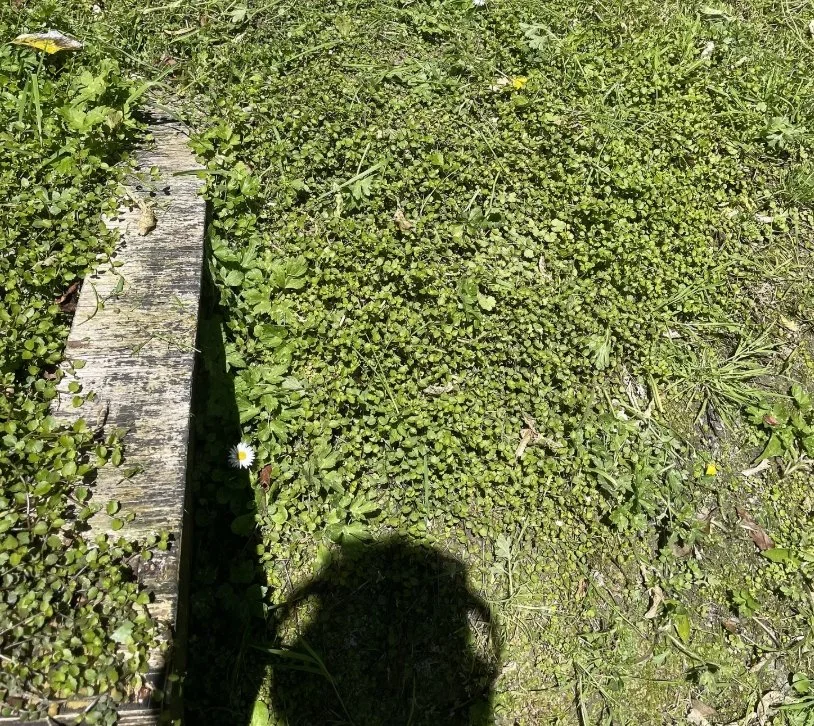
Last one- and my head- hi!
A fave- panakenake- Lobelia Angulata, the native lobelia. This is on a steep slope. I tend to skim mow over it to keep the odd bit of grass down. White flowers. Cute plant. Terribly thin, not dense enough to block out all of the weeds IMO as you can see above. But a nice grass substitute.
Why chuck a couple of different plants in your lawn? Well, most of the lawns above, even in Spring, we only mow four weekly, and even then some of them hardly needed anything. They have better root systems than grass and are more shade tolerant. They have cute flowers. They are better for the soil (as the roots are deeper and it is no longer a monoculture).
Why avoid a no-mow lawn overall? They are still quite a lot of work. You have to weed them or spot spray. There are only a few varieties which I really recommend, and they are recommended based specifically on location, so DON’T JUST TAKE THIS AS RIGHT FOR YOU, but-
Extremely shady/moist most of the year we put down moss- this is easy, just find moss and smush it into your lawn (chop it in with a spade). Your roof will have some, I hope, as will many driveways/bricks…
Part shade- leptinella dioca is the one for us in Wellington.
Full sun (8hrs/day)- thyme is the best in my humble opinion
Are you patient? More patient than that- really patient? Selliera radicans (bonking grass) is the business for your full sun or part shade lawn. It is just beautiful and after a long hard slog of 5 years or so it will create the most beautiful lawn. It is salt tolerant (it loves salt tbh), so we spray our Selliera lawns with a salt spray which keeps many of the weeds down too.
Anyway, lovely to be back, I hope you are all having a fantastic Springtime, and I hope you enjoyed some thoughts on two often time consuming parts of the garden- hedges and lawns- and how to be a bit more chill/ a bit more progressive with them!
If your garden is full of casualties from the storm, please let me know, so I can commiserate with you. RIP my tomatoes and capsicums.