Good morning everyone! I hope you had a lovely week. Christmas is hurrying up fast which means that I am cancelling a lot of plans to spend time in the garden. I hope you are too. I call this Goblin Mode, where I wander out in my PJs and slippers at 9am, returning only to put on sturdier shoes and tie up my hair at midday, and maybe pop in for some food at 3pm.

Last weekend I spent the entire time in the garden and if anyone needed anything they had to come and see me in dirty PJs holding a chicken in one hand and rogue potato plants in another. On the upside they were very polite? I suppose they had to be!
What I’m obsessing over this week
One of our properties has a weird dead patch. We have planted it a few times, and everything has died. It is on a slope, and the building above it is a jewellery studio (where I imagine they do other things as well, it is a large building!). I am very concerned that *something* is being dumped *somewhere, or a pipe is leaking and naughty things are being put down the drains?
This is a needle-haystack situation for me, because all of the usual ways I could narrow down the problem haven’t worked. What I do know is-
After heavy rain, everything that lives on one part of a slope on a hill, will crisp up around the edges of the leaves and start to die.
I know that the older leaves are as affected as the new, which means that this is probably something in the plant’s circulatory system. If it was just older leaves that is generally a deficiency/hunger/life stuff. If it was just newer leaves I would be worried about disease, pests, root damage or over fertilisation.
I know that fertilising and mulching and all of the usual plant-help things don’t make any impact.
I also suspect that, based on the slope of the hill, this is where water from higher up the hill accumulates and starts to drain. We don’t have this problem on other slopes nearby. We do have this problem directly behind a big ol’ commercial building!
Either way I have ordered a soil analysis from Hill Labs, which I have never done before. They were extremely helpful over email so hopefully I have filled it in right- check out all of the options ( after taking this photo I realised I will get a basic soil profile as a part of the soil health profile anyway, but no worries)…
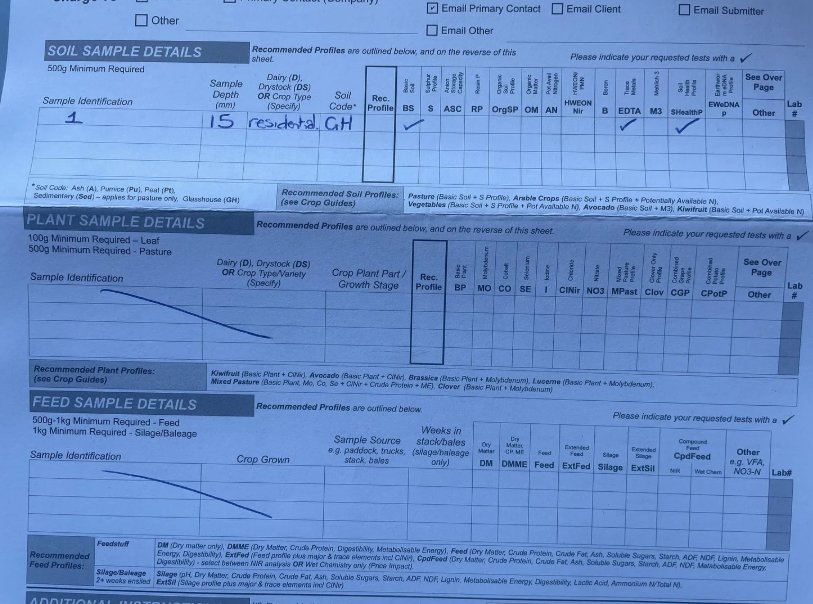
I panicked and wrote ‘Residential’ then coded it as Greenhouse soil. I do not envy the people trying to make head or tail of this!
I’m going to ask my friends who work in Horticulture to help me next time. I imagine Hill Labs will come back and gently tell me what to do for next time too… poor sods.
So this was supposed to be a ‘how to,’ but honestly I think more of us need to confidently throw up our hands and say “here it is, I have asked for help, and followed instructions, and done my best. Please tell me what to do better for next time.”
Because I am looking for weird excesses in the soil which might be killing off my plants, I have asked for a-
Basic soil analysis- which includes volume weight, pH, Olsen phosphorus (this relates to the method of working out how much phosphorus is in the soil and considered the most effective test for working out how mush phosphorus is available for plants), potassium, calcium, magnesium, sodium, C.E.C (Cation Exchange Capacity, essentially this is the ability of your soil to retain nutrients. Think of your soil like a sieve and pour liquid nutrients through the sieve- how many are caught up and able to stay, how many are washed away?), base saturation (How many holes in the sieve are plugged up by alkaline molecules, this is a severe simplification!);
EDTA trace metals- less common metals present in the soil, and normal enough in small amounts, but I am looking for an excess of them;
Soil health profile- includes the amount of Sulphur in the soil, Anion exchange capacity (soils need to retain anions, they are positively charged where cations mentioned above are negatively charged.. the sieve analogy with different things being poured in), organic soil health profile (what is alive in soil, its make up and the form it is in), Hot Water Extractable Carbon (essentially how much carbon is in the soil).
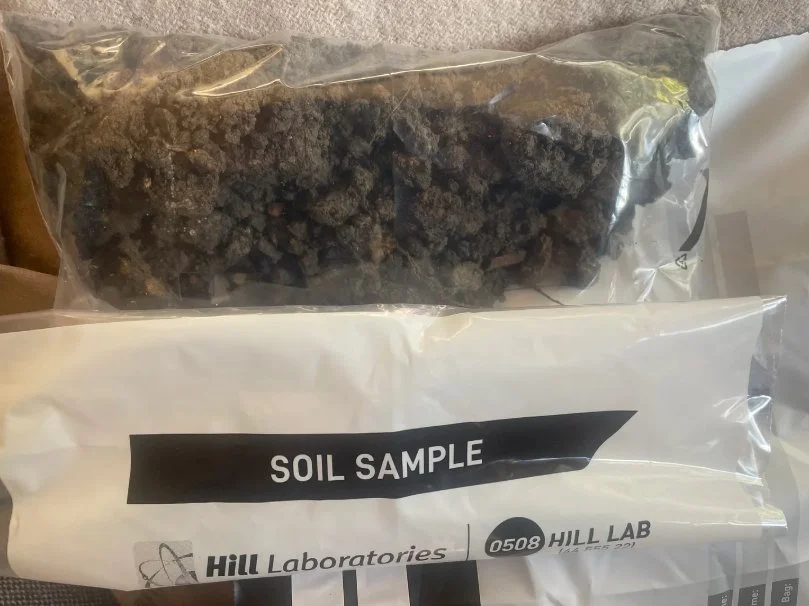
There she is, my beauty- I took 4 separate samples in the affected area. I brushed off the debris on top of the soil and carefully dug out a long cylinder from the top of the soil to about 10cm deep. I did this 4 times in 4 different but similarly affected places, which in this case was all within a square metre. They want about 500g of soil sent on an overnight courier.
All of this soil testing is very well and good if you are able to interpret the results. Usually you would expect to be able to find a healthy range and go from there- eg, a healthy range for nitrogen is 5-10 parts per million (ppm). But if you are growing heavy feeding vegetables, you’d be better off with 25-30ppm. More than 20ppm can ‘lead to leaching and environmental harm,’ so farmers are literally aiming for amounts that are not good for the wider environment. If you have a garden bed full of rhododendrons, I’m sure they don’t need much more than 5 ppm. If you are ordering a soil analysis from Hill Labs, like I am, you need to tell them what you are using the land for, and “my wee house” is not an option, so there is a chance you will receive results with a guide of 25-30ppm nitrogen being optimal.
Yeah, hurts the head eh!
On the upside, if you are worried about your soil, there are less stressful ways to get it tested- ways which will result in your being confident in result interpretation.
If you are worried about contaminants, or specifically metals in your soil, you can get a free test from SoilSafe Aotearoa.
If you are growing fruit and veg, you could ask Seacliff Organics to order you a soil test, I am confident they would give you advice based on the results.
(Why did I use Hill Labs? They run the same tests as Seacliff, Seacliff might even be sending the samples straight to Hill. It is recommended that you always use the same service because they all test in slightly different ways, and the best results would involve your testing multiple times over the year/s. And despite my haphazard way of explaining things, I can interpret the results and take some action, so I’m not too worried about getting a spreadsheet full of numbers.)
Some tasks for this weekend
What lovely weather!
I have started tying up any plant which has suddenly shot up, and is waving around in the wind.
If you have guests or feel overwhelmed, mowing the lawn/weedeating edges will make your garden feel a thousand times more under control.
If you are growing brassicas, pick off all of the caterpillars.
If you are growing flowers, dead head them unless you are collecting seed- this involves cutting the dead flower heads off and will stimulate growth of more flowers.
And have a gin or two! One of my lovely clients just sent us THREE bottles of champagne, I nearly fell over, and as someone who rarely drinks I enjoyed passing them straight on to staff.
Have a fantastic weekend, everyone!